
The Radio Huts of Garuja (Or: Why Shouting at the Desert Still Works)
There are many things that make life difficult on Garuja.
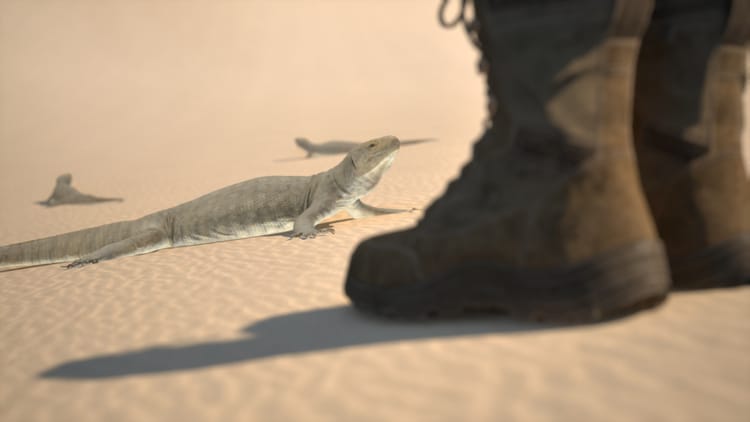
First and foremost, the sand gets into everything. The lizards object to being stepped on. The occasional sandstorm can strip paint from a shuttle faster than most bureaucracies can approve a maintenance request. Communication, however, is a completely different problem.
Most inhabited regions in the Septaluna system are wrapped in layers upon layers of communication infrastructure. Messages travel through planetary networks, orbital relays, commercial providers, government systems, private channels, and enough redundant hardware to ensure that no one can ever successfully claim they never received an invoice. Garuja has none of that.
The reason is surprisingly simple: Nobody lives there.
Or more precisely: not enough people live there to be worth the investment. The moon's population consists primarily of nomadic tribes wandering the deserts, a handful of researchers, and a military base whose glory days ended sometime before its own personnel records began describing it as "temporary."
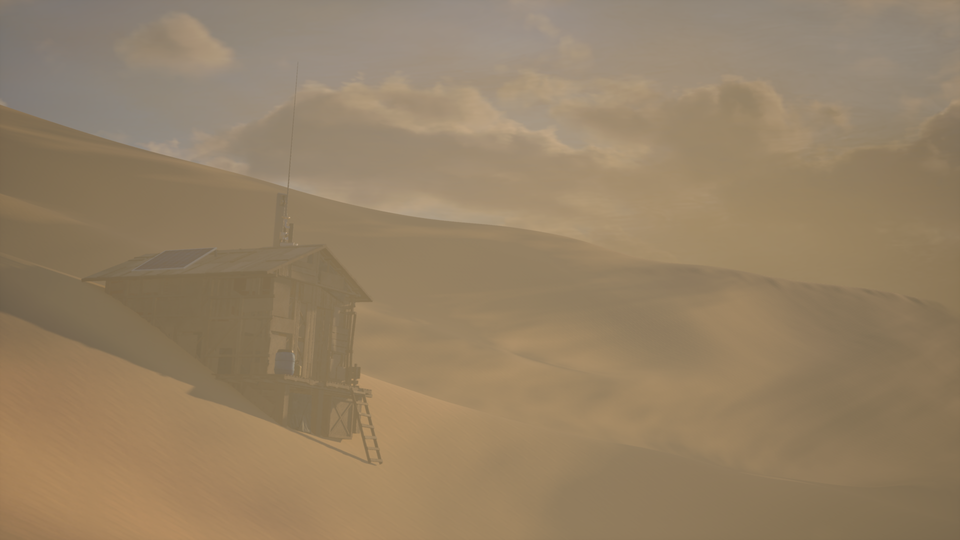
This creates a problem, since even people who choose to live (or keep living) in the middle of a desert occasionally need to send messages. The solution can be found scattered throughout the wastelands in the form of small, sturdy huts. From the outside, these structures appear entirely unremarkable. They are built to survive sandstorms rather than impress visitors, and their architecture can best be described as "still standing". To a traveler, they would look less like pieces of infrastructure and more like stubborn arguments against the desert.
Inside, however, things become slightly more interesting: Every hut contains a radio. Not a private radio. Not a secure radio. A radio. When a transmission is sent from a hut, every other hut capable of receiving the signal can hear it. Nomads, researchers, travelers, military personnel who forgot to switch frequencies, and anyone else carrying a functioning receiver become part of the same conversation whether they intended to or not.
The network is not entirely isolated, however. A small number of huts also serve as planetary relay points. When orbital alignment permits an unobstructed line of sight between Garuja and the main planet, incoming transmissions can be received and rebroadcast throughout the desert. Important messages are therefore known to arrive either instantly or several weeks late, with very little in between.
The system resembles the ancient Citizens Band radio network. It also resembles shouting - the distinction is largely technical. As a result, privacy on Garuja depends less on secrecy and more on mathematics: Messages are routinely encrypted before transmission, and some of the cryptographic systems used across the desert are sophisticated enough to make planetary intelligence agencies deeply uncomfortable.
This occasionally creates unusual situations. A traveler spending the night in a storm shelter may find themselves listening to what appears to be complete nonsense:
"Blue kettle rotates seven times."
"Cloud number forty-two has misplaced its socks."
"The onion arrives tomorrow."
To the casual observer, these statements are meaningless.
To the intended recipient, they may contain shipping manifests, medical requests, financial transactions, navigation data, or invitations to weddings. Nobody asks, because asking would be considered impolite. And it would diminish the system's bandwidth.
Occasionally, messages addressed to "Father Morgana" would appear pinned to the creaking timbers of a hut. No one knows who leaves them. No one knows who collects them. Yet somehow, they never seem to remain unanswered for very long.
The huts themselves occupy a curious position within Garujan society: They belong to nobody, while being maintained by everybody. The nomadic phrase for a well-maintained hut translates, roughly, as a place that remembers you were here. There is no equivalent phrase for a neglected one. The nomads consider the concept self-explanatory. A traveler who discovers a damaged water tank is expected to repair it if possible. Someone finding a faulty antenna is expected to leave instructions, spare parts, or at the very least a strongly worded note for the next visitor. Ownership has proven difficult to establish when nobody remains in one place long enough to care.
The military attempted to catalogue the huts once. This effort produced several hundred pages of reports and absolutely no useful results. Every hut already had a name, most of which were impossible to translate. Several appeared to be inside jokes. One was apparently named after a camel that never existed. In the end, the military assigned identification numbers instead, which were ignored by the nomads. This arrangement has remained stable for decades – which, by Garujan standards, qualifies as a resounding success.
Like much of life on the moon, the radio huts are not elegant, efficient, or particularly modern. They simply solve a problem, and on Garuja solving a problem has always been considered more important than solving it with style.
Septaluna is a narrative adventure game in development. If the universe sounds like somewhere you'd like to spend time, a Steam wishlist helps more than you'd think. Wishlist Septaluna on Steam now!
Member discussion