
"Junk Dunk" - The Anti-Septaluna (Or: I tried making a game I wouldn't get emotionally attached to. That went well.)
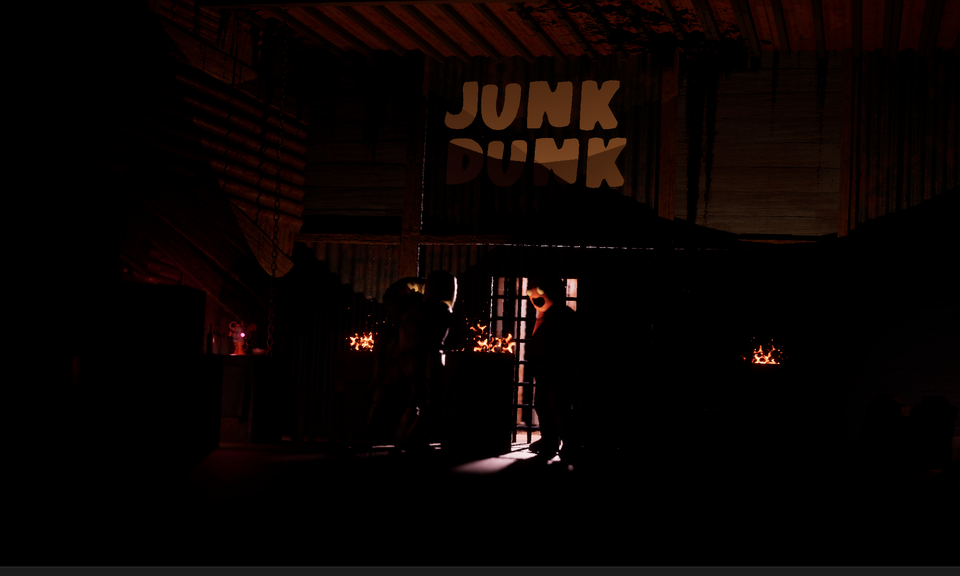
Every game designer knows it: You sit somewhere, let your gaze wander and - there it is: your next game idea!
That squirell running up that tree? How about you had to help it dodge the twigs and get rewarded for every nut you pick up on the way?
That trash can over there? How about a managerial mobile game in which your goal is simply to become the chillest trash tycoon in town?
We all know those stories, and the indie game archetypes they tend to produce. This isn't one of them. Junk Dunk didn't begin with inspiration. It began with the need to build something that wasn't Septaluna.
Working on Septaluna is highly personal for me. I found documents ranging back to 2008, containing the first draft of parts of the story and characters, none of which is in there anymore. The story has kept on evolving with me, always wanting to be told. And it will be - but not yet. In fact, most of the cells in my body will probably have been replaced over the course of the project.
As a developer, on the other hand, I need to stay productive and keep learning (as Dory put it:"Just keep swimming!"). Sometimes that means taking a break from these more personal ties and doing something completely different - something that drops artifacts that can live on their own. That's why I decided to build the "Anti-Septaluna" - a game that is everything my passion project isn't.
It's loud.
It's fast.
It's ridiculous.
It has no story. No lore. No emotional baggage.
It has one simple, repeatable mechanic.
You can finish a match in three minutes or keep playing all evening.
Oh, and it's multiplayer. Local two-player split-screen or up to 8 players online.
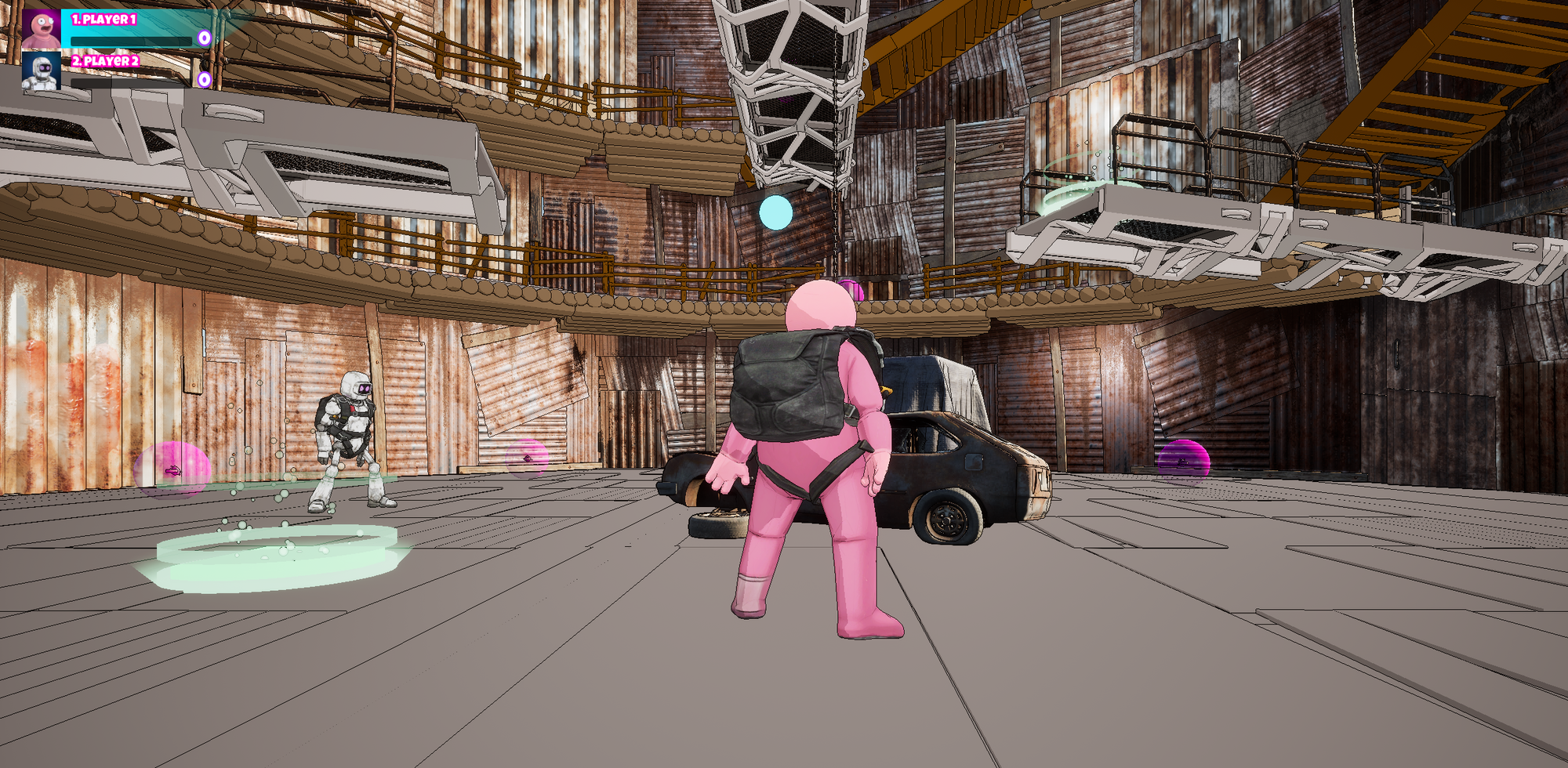
Simple setting: N Players. One Ball. An arbitrary number of items that help you get the ball or keep it.
Depending on the game mode, you win by either scoring most goals in a certain amount of time (Time Brawl), are the first to reach 3 goals (Goal Skirmish) or manage to stay in possession of the ball for the longest time (Hold Your Balls).
The rest is up to the players.
Why this kind of game?
One of my fondest workplace memories is of sitting in the "Landhaus" office and melting away 45 minutes of lunch break playing Unreal Tournament on a self-hosted server with the mates.
While skill mattered, it was always more about the fun - quality time before the second half of the day rolled in and drew us back to our individual tasks. I have learned things about my colleagues I wouldn't ever have been able to see otherwise. Frank, for example, always dominated - I never thought he was a gamer. He taught me better, while always being kind and helpful. It was pure fun losing against those people I didn't know how much I'd miss later on.
There were more situations like this, in other constellations - they involved Among Us, Jackbox, and once even Geocaching. And way further back, in my school days: Competing in F-Zero, Street Fighter, Mortal Kombat and something physical we called Kaiserschießen - a soccer-squash hybrid that left us chasing a ball across our school's yard, dreading its second contact with the ground after ricocheting off the high walls of the gymnasium. I have tried to look the latter up, but couldn't find a description, so we must have made up the name.
Looking at that list now, Junk Dunk suddenly doesn't seem quite as random as I thought. It exists because I decided to make a game that has a very flat learning curve and can be entered and left easily in a lunch break whilst providing stupid fun to a few people who want to have a great time together. Sometimes stupid is exactly what it takes.
Timeline
The project was started exactly ten days before Gamescom 2026. I had a playable two-player split screen prototype with me on the trade show, which I showcased to a stunning number of zero persons. It felt more right to complete it first and rather enjoy the day with friends. Turns out: Good choice, i ran into CodeMonkey and avrona while strolling the business exhibition floors - two people I like to listen to on a more or less regular basis.
Since Gamescom, the greybox has turned into something resembling an actual game. The tower is dressed, most animations are in, the three game modes work, there are more ways to inconvenience your friends, and somehow I now have eight characters ranging from a mummy to whatever the hell Squip is.
The local Split-Screen variant without any netcode has been feature-ready since the end of September, followed by the online-capable version, targetting a few weeks later. Today, I successfully tested a dedicated server and two clients connecting to it*. I will continue to optimize the stage and add boilerplate things like a menu. My goal is to have the game ready for intensive testing mid to late November. The Steam page will come up once I have all items to capture them in a video (soon-ish). It's in preparation.

All of this is happening at a pace that's nothing like Septaluna's slow progress, so I feel I have to say more about that.
Yes, I help myself with AI - deliberately
AI is part of why this experiment can move at this speed.
I've used LLMs before, and even experimented with generative AI on Septaluna. The first dialogue snippets used ElevenLabs-generated voices, which I eventually ditched because the recurring feedback was simply: "feels stiff."
On other projects I already use LLMs heavily for programming and for the glamorous task of reading license terms so I don't have to. Junk Dunk goes further: I use them for C++ work, concept exploration and as part of the 3D asset pipeline.
This doesn't feel particularly revolutionary from where I'm sitting. I've been developing software for about 25 years, and most of that time has involved learning from documentation, books, courses, Stack Overflow, libraries, frameworks and tools made by people much smarter than me.
What has changed is the scale at which I can finish things.

Claude in particular has helped me turn specifications into working artifacts while I curate, test, reject and refine. Instead of exhausting myself tracing scattered information before I can even start solving the problem, I can spend more of that energy on deciding what the problem actually is and whether the result is any good.
We'll see how far that gets me with Junk Dunk.
Last words, for now
Nothing left to say. You can look this game up on junkdunk.app wishlist it on Steam: https://store.steampowered.com/app/5233650/Junk_Dunk/
Turns out that I've become passionate about this one as well - It's just more tangled up with my head than with my heart ;-)
________
* The dedicated server is a headless version of the game
a) for potential ladders, which need a more balanced setup and cheat-safe server authoritative runtime and
b) so the game will stay playable forever**, once bought
** OK, it's obvious that forever is not meant literally, right? But if you have the game binaries and the server binaries, you should be able to set up something that tickles your fancies.
Member discussion